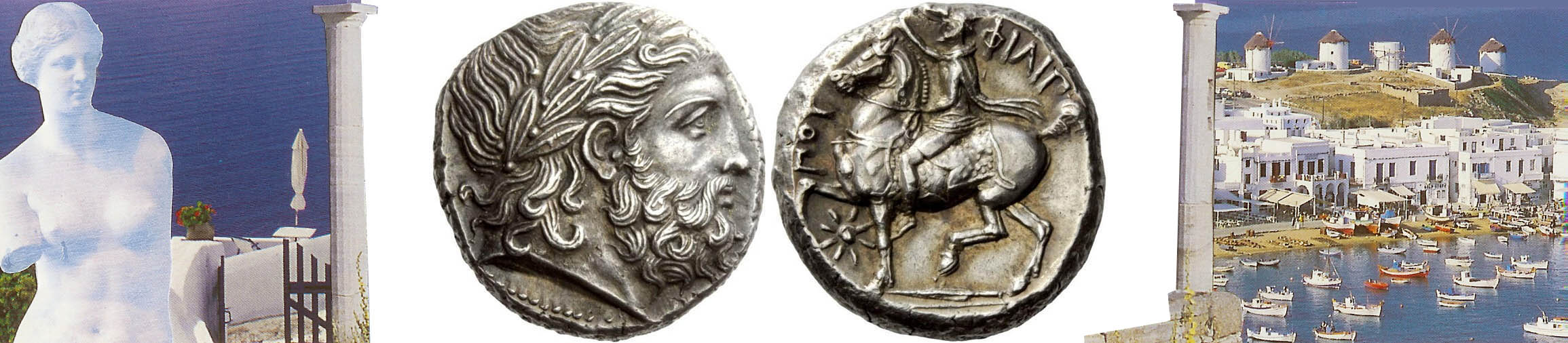

Since remote times, Greece north of the Olympus, Macedonia, was inhabited by the Macedonians, a Greek people, with an innate discipline, who detested the sophistic arguments indulged in by the sophists and their followers in democratic Greece. The Macedonians were blindly loyal to their King.
 Such a radical contradiction in political ideology often caused friction.
The Macedonians were called "barbarians" by a portion of the Athenian citizens headed by the demagogue and orator Demosthenes. At about the end of the Fourth Century B.C., the friction became more intense. Besides, in the opinion of the Macedonian Kings, a new threat from Asia was appearing that menaced the Macedonians firstly as well as the other Greeks south of the Olympus. On the other hand, after the Peloponnesian war, it became clear that the Greeks south of the Olympus, after the victories at Marathon and Salamis, had fallen into a decline, into an incurable political shortsightedness of localized interest.
These developments in Greece and Asia led the King of Macedonia Philip II (357-336 BC) to believe that he should bring political order to the Greeks south of the Olympus as a first step, and to lead an expedition to Asia in order to completely neutralize the Persian danger. His aspirations were strengthened by the Amphictyoniae of the Delphic Oracle's invitation asking him to protect the Sacred Precinct of Delphi from the attacks of their neighbors, the "sacrilegious" Amphissians. This invitation apparently exerted great influence on the ambitious Philip. The Amphictyonic League was a religious as well as a political association that was centered at an Oracle, and whose object was the peaceful settlement of any differences arising between Greek towns. Each member-town was sending two delegates to the annual sessions where decisions were taken by a majority vote. The most important Amphictyonic Leagues were held at Delphi and the island Delos. Whenever a member did not abide by the majority's decisions, the other members had to declare a Sacred war against the transgressor.
The Greek Amphictyonic Leagues may be compared to the modern United Nations Organization. However they were superior to the modern UN because neither Athens nor Sparta, even at their greatest power, had ever tried, at least openly, to pronounce a VETO as great Powers do against smaller Countries in the UN.