
The chief military events - the wars against the Persian empire constitute one of the highlights in Greek history and all mankind
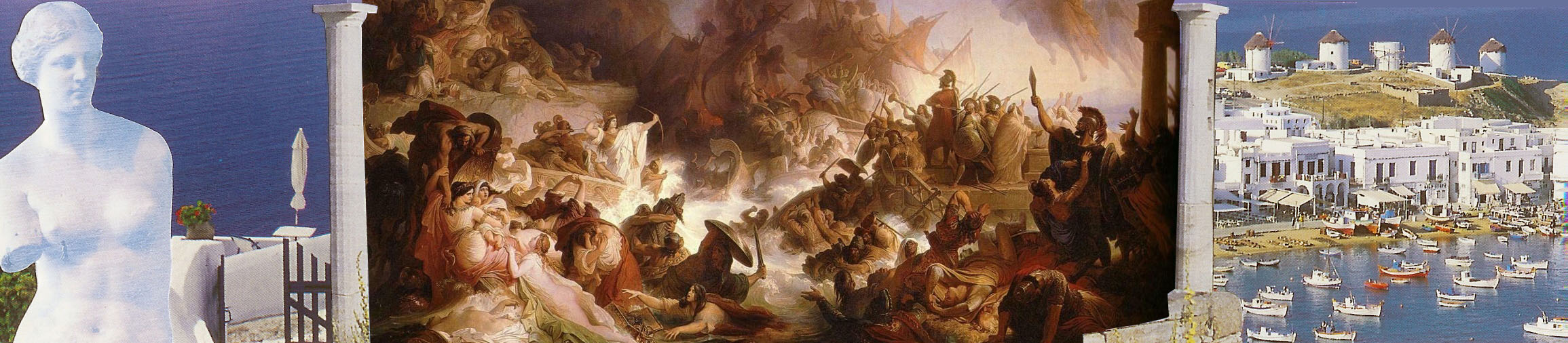
The chief military events of the period may be summarized into two categories. It is firstly the events with the wars in which the Greeks successfully repelled the numerous attempts for invasion and conquest of Greece by the Asiatic Persians. These struggles, the Persian wars, constitute one of the highlights in Greek History, and all Mankind owes gratitude to the Greek Nation for their battles and resistance. "Without the sea-battle at Salamis we would all have been Zoroasters" said the great philosopher Max Miller.
 Secondly, it is the events of the unfortunate and destructive Peloponnesean War, that lasted 27 years (431-404 B.C.) and which the American historian Will Durant, very aptly terms as an act of "suicide" of the Greek Nation.
The Persian wars took place in the 5th cent. B.C. between a large portion of the Greek people and the Persian empire, the successor of the Medes. The cause of the war was the intention of the Persian Kings, Cyrus and Darius, to subjugate the rich Greek colonies on the western coast of Asia Minor. The Greeks, and particularly the Athenians, had rightful aspirations regarding these colonies.
The first Persian expedition was against Athens in particular. A Persian fleet was sent to the island Thasos but the ships were wrecked by violent storms off Mt. Athos (also named Agion Oros).
The Persian army under Mardonius, having lost the fleet, was decimated in Macedonia and returned to Asia. In the spring of 491 B.C. the Persians occupied the Cyclades and then an army landed in Attica, at Marathon in order to attack and conquer Athens. On September 12th 490 B.C. the battle of Marathon was won by the Athenians and other Greek allies, under the leadership of the Athenian General Miltiades. According to the historian Herodotus the Athenians and their allies lost 192 men and the Persians six thousand. The Athenians raised a tumulus, a sepulchral mound, where the Greek dead were buried. The tumulus has been preserved at Marathon, a village located around 27 km north/east from Athens. The Marathon footrace which has been included in the events of the modern Olympic games that were revived in Athens in 1896, originates from the tradition of the messenger who ran with the news of the victory from Marathon to Athens. Up to the time of the Roman conquest of Greece the Marathon victory was celebrated annually as a National holiday.
The second Persian expedition against Greece occurred in the years 480-479 B.C. under the personal command of the Persian King Xerxes, the successor of Darius.
During this second expedition, the Persian land forces met the King of Sparta Leonidas who, leading four thousand allied Greeks held the pass at Thermopylae. After the Persians had succeeded in obtaining positions at the rear of the Greek army, Leonidas embarked the other Greeks on ships and remained alone with three hundred Lacedaemonians who all died to a man, and thus created the immortal legend of the stand at Thermopylae..
After defeating Leonidas at Thermopylae, the Persian land forces advanced southwards, and occupied and completely destroyed the towns of Thespiae, Plataea and Athens.