
Let us now turn to the first Greeks who at about 2000 B. C. migrated from the North to Greece. When they settled at about 1700 B. C. in the Peloponnesus, they learned all about the Minoan civilization which they appropriated, improved, and developed. Thus the Mycenaean Civilization came into being.

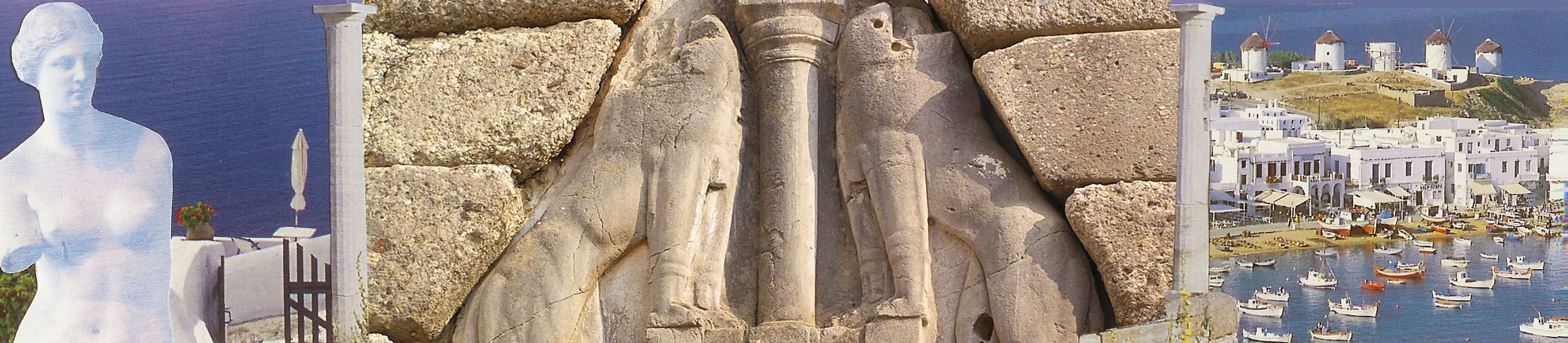
This Mycenaean Civilization is primarily known to us through the Homeric Epics. Homer lived in the 8th century B. C., and, as everybody knows, was the first and greatest Greek poet. The Homeric poems led the archaeologists, the first of whom was the German Schliemann, to excavate Mycenae in the Peloponnesus and Troy in Asia Minor. These excavations brought to light the splendour and opulence of the Mycenaean Civilization, and corroborated the detailed descriptions in the Homeric poems and asserted the historical existence of Homer which up to a time, was doubted. The royal palaces, graves, beehivetombs, walls etc. found at Mycenae, as well as the treasures discovered there and later transported to the Athens Museum, are works of unique and invaluable archaeological importance.
According to the ancient legends the founder of the first dynasty to reign at Mycenae was Perseus, grandson of Acrisius of Argos, in whose reign the land was divided.
Thus the first Mycenaean dynasty of the Perseidae was founded, to which the first acropolis of Mycenae and the aforementioned graves and treasures belonged.
The dynasty of the Perseidae was followed by the dynasty of the Pelopidae, or otherwise Atreidae, from the son of Pelops Atreus, the father of Agamemnon. The Pelopidan dynasty extended its sway over nearly the whole of the Peloponnesus and the nearby islands. It acquired such fame and prestige, that all the important Greek kings of the time, placed themselves under the leadership of King Agamemnon in the great overseas expedition against Troy, to which a few lines will be devoted later on.
The dramatic events connected with the royal house of the Atreidae form the subject of many of the tragedies of Aeschylus, Sophocles and Euripides.
After the Dorian invasion the city of Mycenae declined and in 468 B.C. it was destroyed by the inhabitants of the neighboring city, Argos.
After the Dorian invasion the city of Mycenae declined and in 468 B.C. it was destroyed by the inhabitants of the neighboring city, Argos.